Published January 21, 2026 by Joselina Azucena
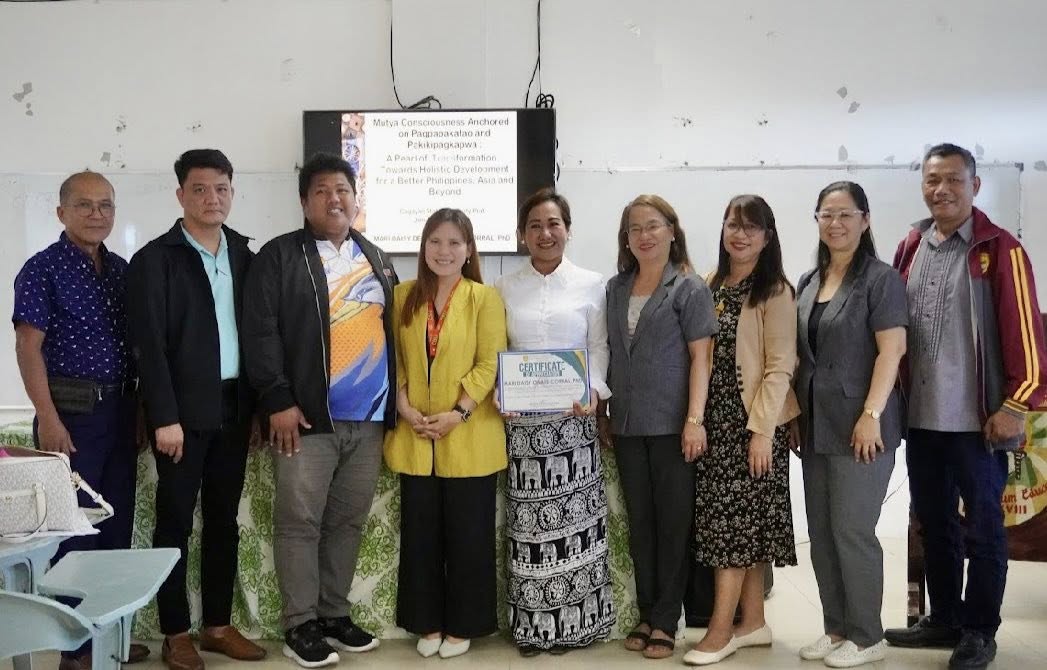
Faculty members of Cagayan State University–Piat Campus gathered for an academic seminar featuring Ms. Mari Daisy Oñate- Corral, PhD, a faculty member of Cavite State University, as the invited speaker, on January 21.
Dr. Corral presented Mutya Consciousness Anchored on Pagpapakatao and Pakikipagkapwa, a framework that draws from her extensive research on Filipino values, ethics, and relational consciousness.
The seminar explored how deeply rooted cultural and philosophical concepts shape human relationships, leadership, and educational practices.
Central to the discussion was “pakikipagkapwa”, which Dr. Corral described as a dynamic ethical and psychological orientation that recognizes the self in the other. She emphasized that pakikipagkapwa fosters empathy, mutual respect, and genuine human connection, making it a foundation for meaningful interpersonal relationships.
According to her, this principle has wide implications for collaboration, leadership, and the educational system, where human-centered engagement remains essential.
Dr. Corral further explained that pakikipagkapwa serves as a pathway to pagpapakatao, or the full realization of one’s humanity and noted that pagpapakatao involves embodying values that reflect the attributes of the divine and revered spiritual ideals—such as compassion, dignity, and moral responsibility. In this sense, recognizing the humanity of others becomes a way of honoring both the self and the sacred.
Connecting theory with personal and cultural experience, Dr. Corral shared insights from her roots as a Piateña. She spoke of Piat’s deeply religious culture, particularly the people’s devotion to Our Lady of Piat, the town’s patroness, as well as the community’s ancient belief in a mermaid dwelling in the Chico River. These narratives, she explained, reflect how spirituality, myth, and communal values shape a collective consciousness that reinforces pakikipagkapwa—seeing the world, others, and even nature as interconnected.
Beyond theoretical discussions, Dr. Corral also shared her journey as a researcher, highlighting the challenges and rewards of sustained scholarly work.
She then discussed possible ways of utilizing her research, including developing educational materials, leadership frameworks, and community-based programs grounded in Filipino values.
The seminar concluded with a sharing of key takeaways from senior and seasoned faculty members. Among those who shared their reflections were University Faculty Regent Prof. Ricardo Casauay, Prof. Herbert Imatong, Associate Prof. Johny Alvarez, Prof. Rowena Sto. Tomas, Asst. Prof. Catherine Allayban,and Prof. Jocelyn Tuliao.
They underscored the relevance of the seminar’s themes to teaching, leadership, and institutional culture.
The activity provided CSU Piat faculty members an opportunity to reflect on the role of indigenous values and relational ethics in strengthening both academic practice and community engagement.
📸kennethcaparida and johnpatrickmaderazo